Author
Samantha Balistreri , Physical Therapist

Close

1 Nov 2026 | ~02:38 Engagement Time
Question from Webinar Participant:
“Could you give me some information on the difference between spasticity and dystonia? My two neurologists are treating me for spasticity, and then I saw a DPT who told me that I have dystonia, not spasticity. Now, I’m just confused.”
Answer from Samantha Balistreri, PT, DPT, NCS:
This is a great question, and I can understand why it would feel confusing to hear different terms from different providers. Spasticity and dystonia can sometimes look or feel similar because both can involve increased muscle activity, tightness, abnormal postures, cramping, or difficulty controlling movement. However, they are not exactly the same thing.
Spasticity is usually related to increased muscle tone or stiffness that occurs because of changes in the nervous system pathways that help regulate muscle relaxation. In MS, spasticity is common and may feel like stiffness, spasms, tightness, or resistance when a muscle is stretched or moved. It can also change depending on position, fatigue, infection, temperature, pain, stress, bladder or bowel issues, and activity level.
Dystonia is more of a movement disorder in which muscles contract involuntarily and may cause twisting, pulling, cramping, or abnormal postures. Dystonia can sometimes be task-specific or position-specific, and may fluctuate depending on movement, fatigue, stress, pain, or other factors.
It is also possible for someone to have features of both, or for one to be more noticeable at different times. That is one reason it can be difficult to sort out without a detailed neurologic and movement exam. That said, you do not necessarily need to get completely caught up in the terminology on your own. While spasticity and dystonia are different neurologic movement/tone problems, there can be overlap in how they are managed, including physical therapy, positioning strategies, stretching or range of motion, trigger management, and sometimes medications or injections.
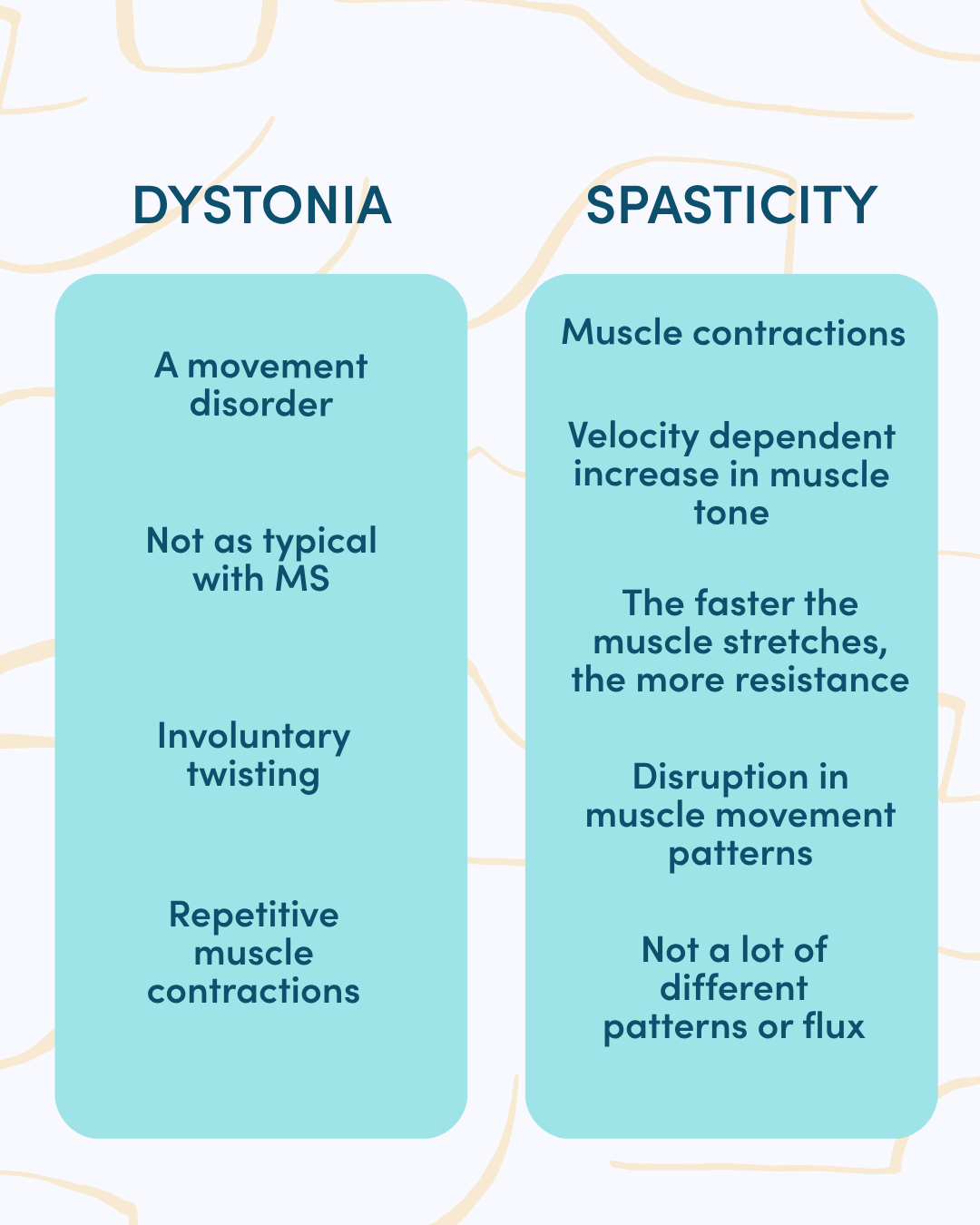
Where the distinction can be helpful is in guiding your care team’s clinical reasoning. For example, spasticity is often more noticeable when a muscle is stretched or moved, while dystonia may be more related to certain positions, tasks, pain, fatigue, stress, or other triggers. For a physical therapist, understanding the difference may help them better anticipate when the muscle activity is likely to happen and how to adjust positioning, movement strategies, bracing, stretching, strengthening, or functional activities.
From a neurology standpoint, the distinction may also matter because medication options and injection planning can differ depending on whether symptoms are primarily spasticity, dystonia, or a combination of both. Some treatments overlap, but they are not always managed exactly the same way. That is why it would be reasonable to ask your neurologist directly whether they think your symptoms are primarily spasticity, dystonia, or both.
If possible, it may also be helpful to take a short video of what you are experiencing at home, especially if the symptoms come and go. Sometimes seeing the movement or posture during a typical episode can help your medical team better understand what is happening.
It can be frustrating to hear different terms from different providers, but your question is very reasonable. The most important step is working with your healthcare team to determine what is driving your symptoms, as that can help guide the most appropriate treatment plan.
Keep Learning...
But wait, there's more...
View All Related to Daily Life with MS: Symptoms